The NPLab investigates the role of topology and geometry in the collective dynamics of complex systems, ranging from neuroscience to society. We do this with statistical mechanics, algebraic topology, snark, and cyberpunk.
16researchers
71papers
14open tools
20alumni
Research themes and projects
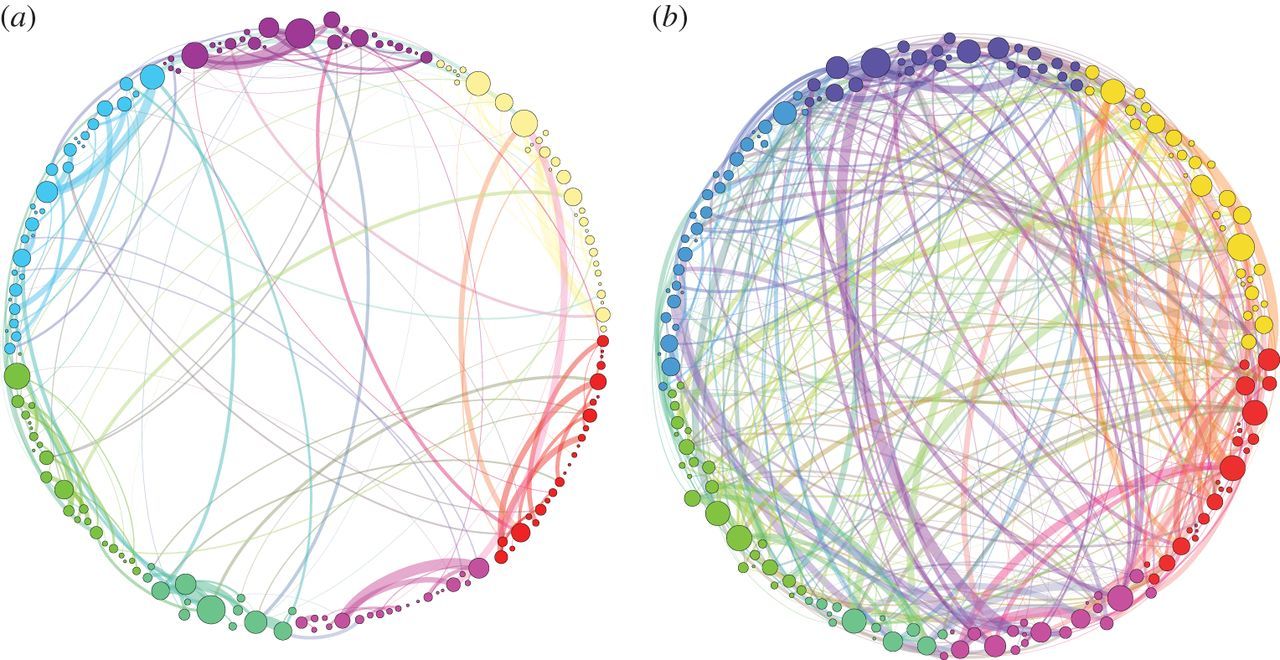
Topological Neuroscience
We study when brain activity is better described by interactions among groups of regions than by pairs, and…
Cognitive and NeuroAI
We study how the organization of representations shapes learning, generalization, and the ability to perform…
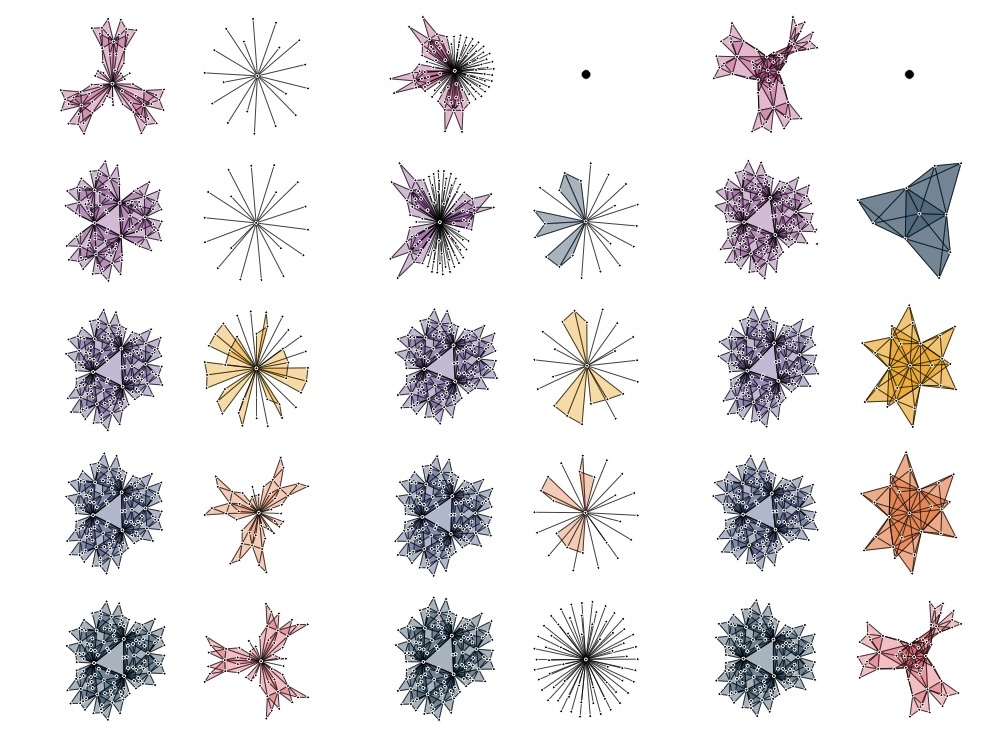
Network Foundations
We develop mathematical tools to understand how network structure shapes dynamics, across interaction orders…

Project CETI
We study how sperm-whale vocal communication relates to social interaction, coordination, and foraging,…
RUNES
RUNES asks how interactions among groups shape information processing and collective behavior, and how those…
Latest
-
Welcome Daniele and Matt!
Daniele Savietto and Matt Stevenson have joined NPL as PhD students at the Network Science Institute. Welcome to the lab!Daniele Savietto and Matt Stevenson have joined NPL as PhD students at the Network Science Institute. Welcome to the lab!In the news archive -
New blindsight preprint out!
Davide's new preprint Preserved brain hierarchy supports residual vision without awareness after visual cortex damage is out on bioRxiv! In the…Davide's new preprint Preserved brain hierarchy supports residual vision without awareness after visual cortex damage is out on bioRxiv! In the largest resting-state fMRI cohort of patients with unilateral V1 damage reported to date, we show that blindsight-positive patients preserve the sensory-to-association cortical hierarchy, while blindsight-negative patients show a marked flattening of it driven by abnormally low shared-information coupling within unimodal cortices.In the news archive -
We are hiring: Postdoc in Topological Machine Learning and Generative AI!
We are looking for a Postdoctoral Research Associate in Topological Machine Learning and Generative AI to lead our contribution to TOPO-LLM, bringing…We are looking for a Postdoctoral Research Associate in Topological Machine Learning and Generative AI to lead our contribution to TOPO-LLM, bringing persistent homology and higher-order network methods to bear on large language models for innovation intelligence. Ten months, EUR 64,000, based at the Dublin Innovation Institute - Northeastern University. Applications close at 12pm on 9 September 2026.In the news archive -
TOPO-LLM wins FFplus (EuroHPC) funding!
Our proposal TOPO-LLM: Topologically-Informed Large Language Models for Innovation Intelligence has been awarded funding through the FFplus EuroHPC…Our proposal TOPO-LLM: Topologically-Informed Large Language Models for Innovation Intelligence has been awarded funding through the FFplus EuroHPC Second Open Call! Gio joins as Scientific Advisor on the project, which brings pre-exascale European HPC to bear on topologically-informed generative AI for innovation intelligence.In the news archive
Join us
Open positions
None open right now
PhD students, visitors and collaborations: we are always glad to hear from you.
Recently closed: Postdoc in Topological Machine Learning and Generative AI (9 Sep 2026)
How to joinTools & data
Harmonic Degree
GitHub ↗Code for assessing network coarse-graining quality via harmonic morphisms and dynamical invariants.
Higher-Order Laplacian Renormalization
GitHub ↗Python code to perform higher-order Laplacian renormalization of higher-order networks.
Modelling TUS
GitHub ↗Python code to reproduce the computational model of transcranial ultrasound stimulation (TUS) at different stimulation intensities.
Social-Asocial Learning
GitHub ↗Code to reproduce the network analysis from 'Social and asocial learning in zebrafish'.
XGI
GitHub ↗CompleX Group Interactions: a Python package for higher-order networks, with hypergraphs and simplicial complexes.
Sperm Whale Foraging Tactics
GitHub ↗Code and derived data for the multiscale analysis of sperm-whale foraging: persistent search paths and flexible prey-capture tactics.