Nurisso, M., Fernando, J., Deshpande, R., Perotti, A., Marjieh, R., Frankland, S. M., Lewis, R. L., Webb, T. W., Campbell, D., Vaccarino, F., Cohen, J. D., Petri, G.
ICLR
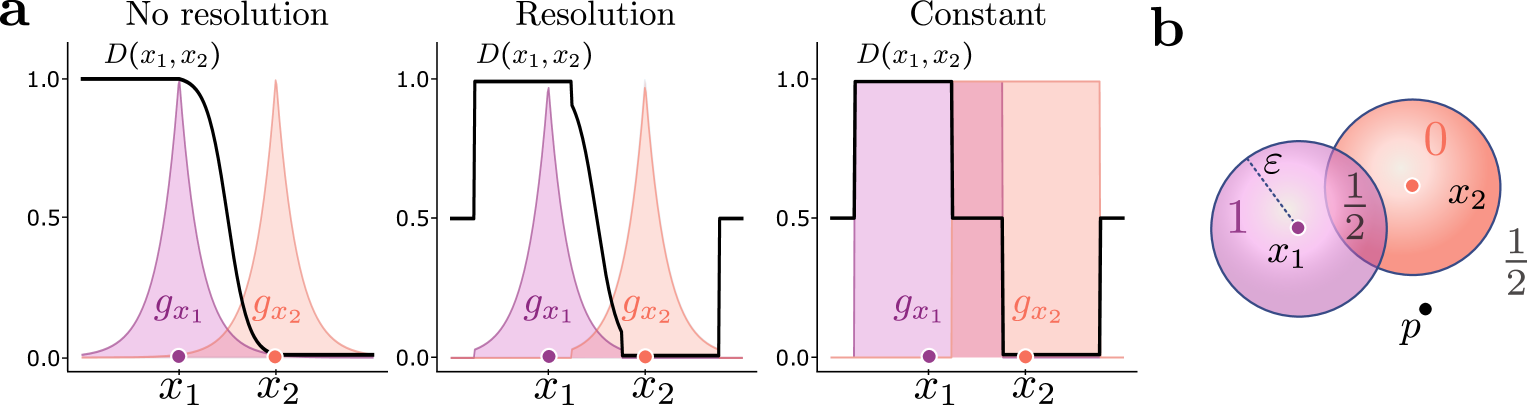
Intelligent systems must deploy internal representations that are simultaneously structured — to support broad generalization — and selective — to preserve input identity. For any model whose representational similarity between inputs decays with finite semantic resolution, we derive closed-form expressions that pin its probability of correct generalization and identification to a universal Pareto front independent of input space geometry. A minimal ReLU network trained end-to-end reproduces these laws: during learning a resolution boundary self-organizes and empirical trajectories closely follow theoretical curves. The same limits persist in two markedly more complex settings — a convolutional neural network and state-of-the-art vision-language models — confirming that finite-resolution similarity is a fundamental emergent informational constraint.
Cognitive and NeuroAIRUNES