Research

Project CETI

We study how sperm-whale vocal communication relates to social interaction, coordination, and foraging, combining acoustic and movement data with models of collective behavior. Our work covers cooperation among non-kin during a birth and the shifts in the whales' codas around it, social learning across the cultural boundaries between clans, and foraging that combines persistent search with flexible prey capture. It is part of Project CETI (Cetacean Translation Initiative), whose wider aim is to understand sperm-whale communication well enough to translate it.

Papers 5

  • Maalouf, A. et al. 2026

    Maalouf, A., DelPreto, J., Lucas, M., Poetto, S., Andreas, J., Torralba, A., Gero, S., Petri, G., Rus, D., Gruber, D. F.

    Science

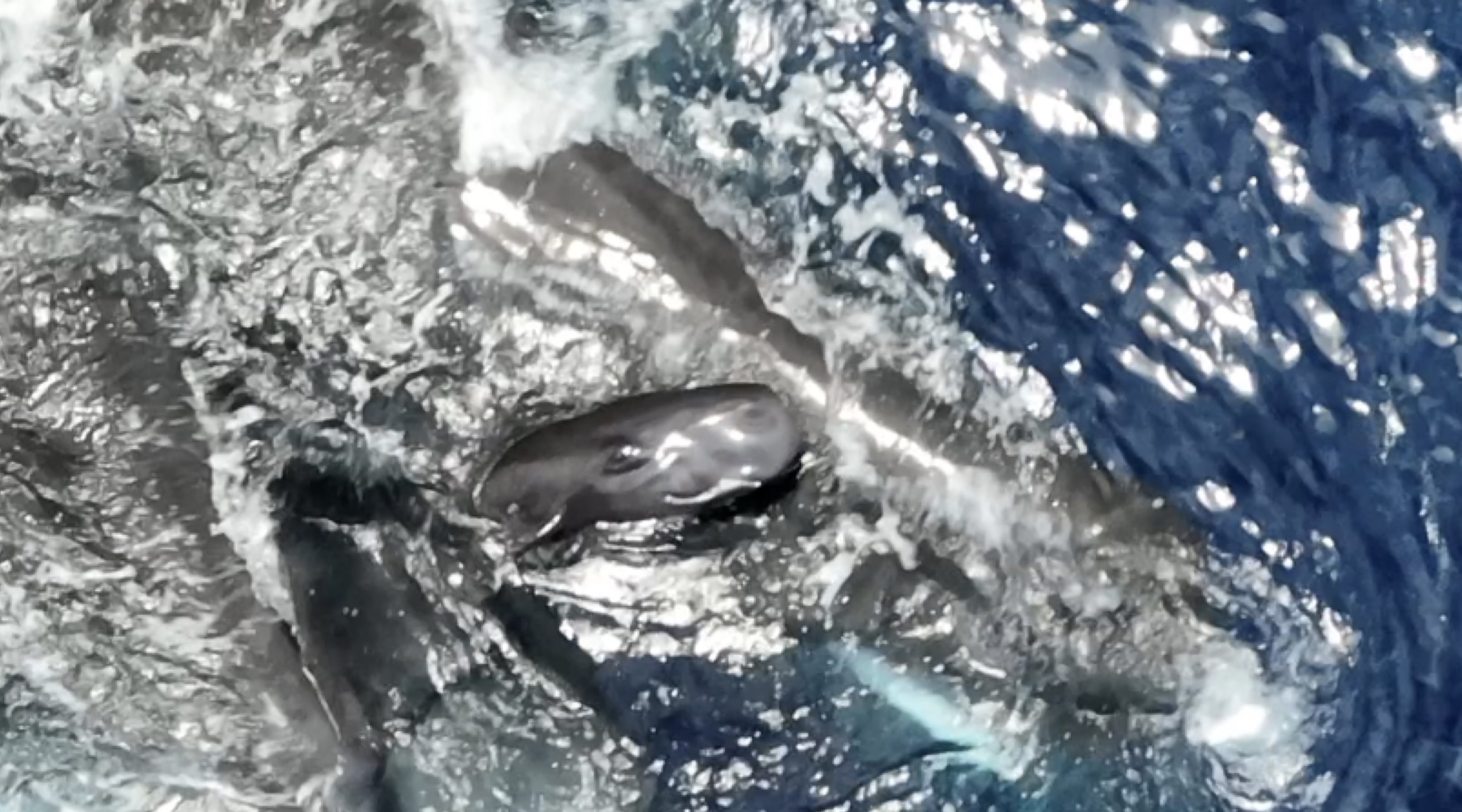
    We quantitatively document a sperm whale birth event, revealing collective support behaviors across kinship lines. Using high-resolution drone footage, computer vision, and multiscale network analysis, we studied the interactions within a Caribbean sperm whale unit comprising two matrilines. Our results suggest that a female family member led birth assistance and that after delivery, all individuals oriented toward and helped lift the newborn, taking turns in a coordinated, cross-kin effort. Despite historically observed foraging segregation, kinship barriers dissolved as all unit members contributed. These analyses provide evidence of birth attendance, or assistance, in a nonprimate species, a behavior long considered characteristic only of humans and their close relatives.

    Project CETIRUNES

  • Zaffina, L. et al. 2026

    Zaffina, L., Monti, C., Poetto, S., Lucas, M., Machado Borges, H. J., Deshpande, R., Tonnesen, P., Gruber, D., Gero, S., Santoro, A., Petri, G.

    bioRxiv

    Predators searching patchy environments must coordinate movements across scales, yet this behavioural hierarchy is not yet technically possible to observe in the deep ocean. Here we show that sperm-whale foraging is organized across two nested levels: directionally persistent search paths and flexible prey-capture tactics. We combine acoustic recordings with reconstructed three-dimensional trajectories from 34 sensor-tag deployments on 20 individual whales in both the eastern Caribbean and the mid-Atlantic. Complete foraging paths exhibit heavy-tailed step lengths and superdiffusive displacement, consistent with Levy-like search. Within these paths, echolocation buzzes resolve into two recurrent acoustic-kinematic tactics, and every sampled whale used both, switching between them within dives. Together, these results reveal a foraging hierarchy in which flexible capture actions unfold within persistent, deliberate large-scale search.

    Project CETIRUNES

  • Aluma, Y. et al. 2026

    Aluma, Y., Baron, Z., Barrett, R., Baumgartner, C., Beguš, G., Bhattacharya, S., Bronstein, M. M., Dahan, S., Davis, O., de Haas, S., Defoe, J., DelPreto, J., Dessi, R., Diamant, R., Gatesy, J., George, K., Gero, S., Gibbons, D., Gibbons, D., Gil, S., Goldwasser, S., Gruber, D. F., Harve, O., Hernandez, A., Ishay, M., Jadhav, N., KC, L., Kenny, A., Leitao, A., Lucas, M., Maalouf, A., Malkin, P., Mevorach, Y., Pagani, S., Paradise, O., Petri, G., Poetto, S., Rossi, E., Rus, D., Salino-Hugg, M., Santoro, A., Sharma, P., Tchernov, D., Torralba, A., Tønnesen, P., Vogt, D. M., Wood, R. J.

    Scientific Reports

    Wild cetacean birth observations are extremely rare, with observations having been recorded in less than 10% of cetacean species. Here, we describe a detailed accounting of a sperm whale (Physeter macrocephalus) birth off the coast of Dominica within a well-documented social unit and consisted of sperm whales collaboratively lifting the newborn out of the water. We recorded data via multiple concurrent methods: underwater audio, aerial drone video, shipboard photography in addition to behavioral observations spanning before, during and after the whale birth. All 11 members from sperm whale “Unit A” were present and participated in the birth, which lasted 34 min from the time the flukes emerged until the completion of delivery. The sperm whale unit made extensive vocalizations, with statistically significant shifts in coda vocal style corresponding to key events, such as the beginning of the birth and interactions with short-finned pilot whales (Globicephala macrorhynchus) shortly after the birth event. An evolutionary analysis of wild cetacean births suggests that newborns being lifted out of the water dates to before the most recent common ancestor of toothed and baleen whales, >36 million years ago, and that cooperative lifting of the newborn is noted, thus far, only in members of Odontoceti (toothed whales). This study provides the most in-depth observations of a wild cetacean birth.

    Project CETIRUNES
  • Leitao, A. et al. 2024

    Leitao, A., Lucas, M., Poetto, S., Hersh, T. A., Gero, S., Gruber, D., Bronstein, M., Petri, G.

    eLife

    We provide quantitative evidence suggesting social learning in sperm whales across sociocultural boundaries, using acoustic data from the Pacific and Atlantic Oceans. Traditionally, sperm whale populations are categorized into clans based on their vocal repertoire: the rhythmically patterned click sequences (codas) that they use. Among these codas, identity codas function as symbolic markers for each clan, accounting for 35-60% of codas they produce. We introduce a computational method to model whale speech, which encodes rhythmic microvariations within codas, capturing their vocal style. We find that vocal style-clans closely align with repertoire-clans. However, contrary to vocal repertoire, we show that sympatry increases vocal style similarity between clans for non-identity codas, i.e. most codas, suggesting social learning across cultural boundaries. More broadly, this subcoda structure model offers a framework for comparing communication systems in other species, with potential implications for deeper understanding of vocal and cultural transmission within animal societies.

    Project CETI

  • Andreas, J. et al. 2022

    Andreas, J., Begus, G., Bronstein, M. M., Diamant, R., Delaney, D., Gero, S., Goldwasser, S., Gruber, D. F., de Haas, S., Malkin, P., Pavlov, N., Payne, R., Petri, G., Rus, D., Sharma, P., Tchernov, D., Tønnesen, P., Torralba, A., Vogt, D., Wood, R. J.

    iScience, 25(6)

    Machine learning has been advancing dramatically over the past decade. Most strides are human-based applications due to the availability of large-scale datasets; however, opportunities are ripe to apply this technology to more deeply understand non-human communication. We detail a scientific roadmap for advancing the understanding of communication of whales that can be built further upon as a template to decipher other forms of animal and non-human communication. Sperm whales, with their highly developed neuroanatomical features, cognitive abilities, social structures, and discrete click-based encoding make for an excellent model for advanced tools that can be applied to other animals in the future. We outline the key elements required for the collection and processing of massive datasets, detecting basic communication units and language-like higher-level structures, and validating models through interactive playback experiments. The technological capabilities developed by such an undertaking hold potential for cross-applications in broader communities investigating non-human communication and behavioral research.

    Project CETI

Tools & data